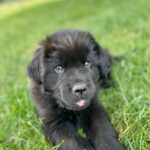
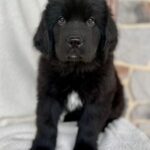
1. How large do your Newfoundlands grow?
Males routinely reach 130 to 150+ pounds, while females average 100 to 120 pounds. They are a giant breed that requires adequate space to navigate safely.
2. Do your Newfoundlands drool?
Yes. Newfoundlands have a specific loose lip structure that naturally retains saliva. They will drool, especially after drinking water, during exercise, or when food is being prepared. A “dry-mouth” gene does not exist in ethically bred Newfoundlands.
3. What is their temperament like with children?
Newfoundlands are world-famous as “nanny dogs” due to their immense patience, gentleness, and protective nature over children. However, due to their sheer size as growing puppies, supervision is always required around small kids.
4. What health testing do you perform on your adult dogs?
Our breeding dogs undergo rigorous orthopedic, cardiac, and genetic testing prior to any breeding. This includes official OFA clearances for hips, elbows, heart, and cystinuria to ensure genetic health.
5. Do your puppies come with a health guarantee?
Yes. Every puppy leaves with a short-term 72-hour health guarantee requiring a standard vet check, alongside a comprehensive 2-year genetic health guarantee covering crippling, life-threatening hereditary conditions.
6. Why is “slow growth” so important for a giant breed?
A Newfoundland puppy grows at an incredibly rapid rate, but their skeletal system takes 18 to 24 months to fully mature. Feeding large-breed specific puppy food and limiting high-impact exercise (like jumping or running on hard surfaces) prevents structural joint damage.
7. Are Newfoundlands easy to train?
Newfoundlands are highly intelligent, eager to please, and generally responsive to training. However, because they grow so rapidly, gentle but firm obedience training must begin on day one. It is vital to teach them loose-leash walking and to discourage jumping immediately, as a 140-pound dog that pulls or jumps can become a major safety hazard. They respond best to positive reinforcement and praise; harsh corrections will easily crush their sensitive spirits.
8. Do Newfoundlands bark a lot?
As a general rule, Newfoundlands are not nuisance barkers. They are naturally calm observers who typically only bark to alert you to someone at the door or if they sense a structural change in their environment. When they do bark, it is a remarkably deep, booming sound that serves as an excellent natural deterrent to intruders, despite their lack of actual aggression.
9. How well do they handle hot weather?
Because of their heavy, insulating double coats, Newfoundlands do not tolerate extreme heat well. During hot summer months, they must have constant access to air conditioning, plenty of fresh water, and shaded areas. Exercise should be restricted to the early morning or late evening when temperatures are cooler. Many owners also provide shallow wading pools, as Newfies love to cool off in water. Never shave a Newfoundland’s coat in the summer, as their double coat actually protects their skin from sunburn and helps regulate their body temperature.
10. Are they good swimmers?
Swimming is practically second nature to this breed. Newfoundlands possess specialized webbed feet, a water-resistant coat, and a natural breaststroke swimming style rather than a typical dog paddle. While they absolutely love the water, young puppies should always be supervised during their first few swims to ensure they can find their way out of a pool or gentle current safely.